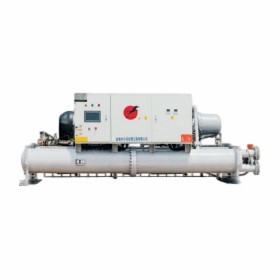
By separating hot and cold fluids through a solid wall, heat transfer sequentially undergoes three stages: convection heat transfer in the hot fluid, conduction heat transfer through the solid wall, and convection heat transfer in the cold fluid. In the most common indirect heat exchanger, conduction and convection are the primary heat transfer methods. The hot fluid first transfers heat to one side of the tube wall via convection, then conducts heat from one side of the tube wall to the other, and finally, the other side of the tube wall transfers heat to the cold fluid via convection, thus completing the heat transfer process. This principle ensures that the fluids do not come into direct contact during operation, avoiding cross-contamination and making it suitable for industrial applications requiring high fluid purity.
Plate heat exchangers consist of two welded plates formed using a die-pressing process. Internal channels for hot and cold media flow are incorporated, and the plates are arranged to form various heat exchange loops. Shell-and-tube heat exchangers, on the other hand, separate the hot and cold fluids through a solid wall, with heat exchange achieved through wall-to-wall transfer.
The higher the flow velocity of the medium within the heat exchanger, the greater its heat transfer coefficient. Therefore, increasing the flow rate of the medium in the heat exchanger can greatly improve the heat exchange effect. However, the negative impact of increasing the flow rate is that it increases the pressure drop through the heat exchanger and increases the energy consumption of the pump. Therefore, there must be a suitable range.