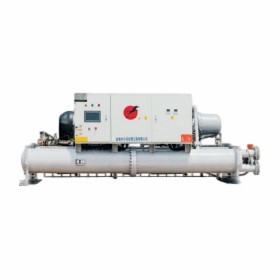
Surface heat exchangers mainly include shell-and-tube, double-tube, and other types.
Shell-and-tube heat exchangers comprise five basic configurations:
Fixed tubesheet type: The tube bundle is rigidly connected to the shell, suitable for conditions with small temperature differences. Fixed tubesheet heat exchangers have a simple structure, low cost, and are easy to manufacture. Tube-side cleaning and maintenance are convenient. However, shell-side cleaning is difficult, and thermal stress exists in the tube bundle after manufacturing. They are suitable for conditions where the temperature difference between the two media is small (generally below 30°C), or where the temperature difference is large but the shell-side pressure is not high.
Floating head type: One end of the tube bundle can float freely to compensate for thermal expansion stress. The advantages of floating head heat exchangers are that the temperature difference between the shell and the tube bundle is not restricted, tube bundle cleaning and maintenance are relatively convenient, and both the tube-side and shell-side are easy to clean. The disadvantages are complex structure, high sealing requirements, and difficulty in online handling of leaks. Floating head heat exchangers are generally used in chemical unit operations with large temperature differences.
U-tube type: The heat exchange tubes are bent into a U-shape, automatically eliminating thermal stress.
U-tube heat exchangers overcome the disadvantages of fixed tube sheet and floating head heat exchangers, but the U-shaped bends are difficult to clean thoroughly, and tube replacement is relatively difficult. They are suitable for conditions where the temperature difference between the two fluids is large and the shell side is prone to scaling.
Stuffed box type: A packing seal is used between the floating tube sheet and the shell.
Bottle structure: Designed specifically for steam heating applications.
Plate heat exchangers use a die-pressing process, with two welded plates forming a single heat exchange unit. Multiple flow loops are created by changing the corrugation shape and arrangement. Its compact structure can improve the heat transfer coefficient by 50%-200% compared to shell-and-tube equipment.
Plate heat exchangers are high-efficiency heat exchangers, characterized by small size and footprint; high heat transfer efficiency, enabling enhanced heat transfer at low speeds; easy assembly; low heat loss; easy disassembly, cleaning, and maintenance; and long service life. The disadvantages are a long sealing perimeter, making it prone to leakage; an operating temperature below 150℃; low pressure differential tolerance; and limited capacity. Once scaling is detected on the plates, they must be disassembled and cleaned.
Furthermore, there are extensions to surface heat exchangers, such as plate-fin and tube-fin types.